The Complete Guide to B2B Prospecting in France in 2026
The four steps of B2B prospecting that gets replies in France: start from the person to reach, pick the channel, write a short message, follow up. With the tools for each step.
You run a services firm and your clients mostly come from your network. One day, the network is not enough. B2B prospecting means going after the next clients yourself: find the right person, write to them, get a reply.
This guide follows that order. For each step, it says what to do and with which tools.
What B2B prospecting is
B2B prospecting means contacting people in companies that could buy your service. You do not sell to a company: you write to a person who decides for it.
That is why everything starts from that person, not from a list of companies.
Their LinkedIn and their email, in one sentence.
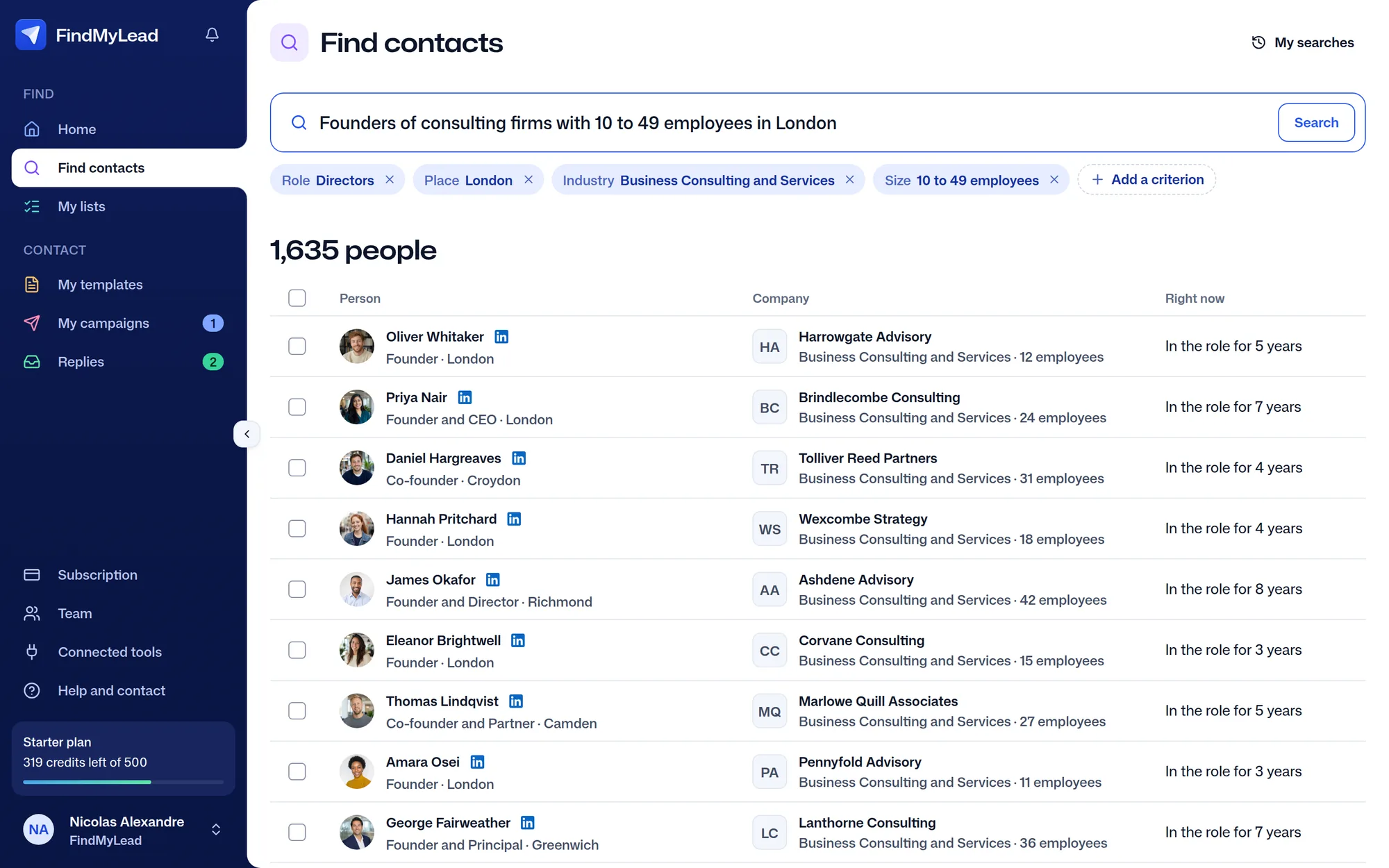
Directors of consulting and services firms in Lyon, 10 to 49 employees
Free
The 4 steps of B2B prospecting that gets replies
1. Targeting: start from the person
First describe who you want to reach, with three criteria:
- the job: the director, the HR director, the finance director, the sales director;
- the place: a city, a département, a region;
- the company size: for example 10 to 49 employees.
Add a sector if your offer needs it. “Finance directors in Paris, companies with 20 to 200 employees” is a target. “SMEs” is not.
The job depends on what you sell. An HR firm aims at the HR director, an accountant at the finance director, a sales trainer at the sales director. In a company under 50 people, the director often decides everything: aim at them first.
Sites that republish the public registers, such as Pappers or Societe.com, say which companies exist and who legally represents them. They say neither who runs HR nor how to reach that person. They help you check a company, not build your list.
2. The channel: LinkedIn, then email
Many directors of small services firms prospect on LinkedIn first. The profile shows the person’s job, company and background. A short message, after an accepted invitation, gets read.
Email complements LinkedIn. It reaches people who are rarely on the network and leaves a written trace. It needs verified addresses and a well-configured sending domain: our guide to email deliverability covers SPF, DKIM and warm-up.
The phone stays useful after a first written exchange. The person already knows your name when you call.
3. The message
Your message answers three questions in a few seconds: who you are, why you are writing to this person, and what they gain.
- Open on their situation, not on your company.
- Cite one precise fact about them or their company.
- Stay under 100 words, readable on a phone.
- Ask for little: a question they can answer in one line, not an hour-long meeting.
Writing one message per person takes time. On FindMyLead, the AI writes a LinkedIn message and an email for each person, from their job, their profile and their company’s description. You review before sending.
4. The follow-up
A good share of replies only comes after a follow-up. Plan two or three follow-ups, a few days apart, each with a new angle: a client example, a question, a useful figure. Our 3-email follow-up sequence gives a template.
Stop as soon as the person asks not to hear from you again.
The tools for each step
A tooled-up prospecting setup often combines three pieces: a source of people, a tool that finds emails, a sending tool.
- Find the people: LinkedIn and Sales Navigator by hand, or a people database such as Apollo or Pharow.
- Find the emails: Dropcontact, Hunter or Kaspr, from a name or a profile.
- Send and follow up: lemlist or La Growth Machine.
- Track: a CRM such as HubSpot or Pipedrive.
Our comparison of prospecting tools sets them side by side, prices included.
FindMyLead brings the first three pieces together. You describe the people in one sentence and see for free how many there are, with their job, company and LinkedIn profile. Example: “HR directors of companies with 50 to 500 employees in Lyon”, 811 people in October 2026 (the managers’ use case).
A credit pays for one contact and their LinkedIn profile. Their work email is looked up at no extra credit, found or not. Emails go out from addresses created in your company’s name, with automatic follow-ups. FindMyLead costs €69 a month for 500 credits, for the whole team, and connects to HubSpot (our pricing).
FindMyLead never acts on your LinkedIn account: you open the profile and send the prepared message yourself.
What is different in France
French law, as read by the CNIL, lets you write to a work address without prior consent, if your offer concerns the person’s profession. You tell them where their details came from, and they can refuse further messages. It is all in our article on GDPR and B2B prospecting.
Formal address (« vous ») remains the rule in a first message. Then adapt the tone to the sector: an agency will accept a lighter touch than a law firm.
Public company data is rich in France. Pappers shows the director’s name, role and age for free (Doctolib’s page on Pappers, for example). These pages name the legal representative, not the HR or finance director, and the free page gives neither their LinkedIn profile nor their email.
Measure what counts
Count the replies written by people, then the meetings. Open rates read poorly: several mail apps open emails on the recipient’s behalf. To place your numbers, see our B2B cold email benchmarks for France.
Also note where the replies come from: which job, which company size, which message. That tells you where to focus next.
Where to start
- Write your target in one sentence: job, place, company size.
- Build a first list of about a hundred people.
- Write a short message, centred on the person, that asks a question.
- Send, follow up twice, and count the replies.
- Keep the target and the message that get replies, change the rest.
A small amount every week beats a big campaign that gets dropped. Next, read how a consulting firm fills its pipe without a network.
Frequently asked questions
How do I start B2B prospecting if I have never done it?
Pick a job, a place and a company size you already know. Build a list of about a hundred people, write them a short message, and follow up twice before judging.
Should I choose LinkedIn or email?
Both. LinkedIn first for directors who are active there, email for the others and for follow-ups. The phone comes after a first exchange.
Is B2B cold email legal in France?
Yes, to a work address, if the offer concerns the person’s profession. They must know where their details came from and be able to refuse further messages easily.
How many follow-ups should I send?
Two or three, a few days apart, each with a different angle. Beyond that, change the target or the message rather than insisting.