The 10 Best Sales Prospecting Techniques in 2026
Ten techniques to find B2B clients in 2026, from finding the right people by job title to cold email, LinkedIn and referrals. For each: how to do it and who it suits.
Sales prospecting means going after your next clients instead of waiting for them. In a services firm of 10 to 49 people, the director often does it, between two engagements.
Here are ten techniques, from the most direct to the slowest. For each: how to do it, and who it suits.
1. Find people by their job title
Everything starts with the right person. Not a company, not contact@: the director, HR director, finance director or sales director who decides on what you sell.
Describe them with three criteria: their job, their place, their company’s size. “HR directors in Bordeaux, companies with 20 to 200 employees” is a precise search. On LinkedIn, you run it by hand, profile by profile.
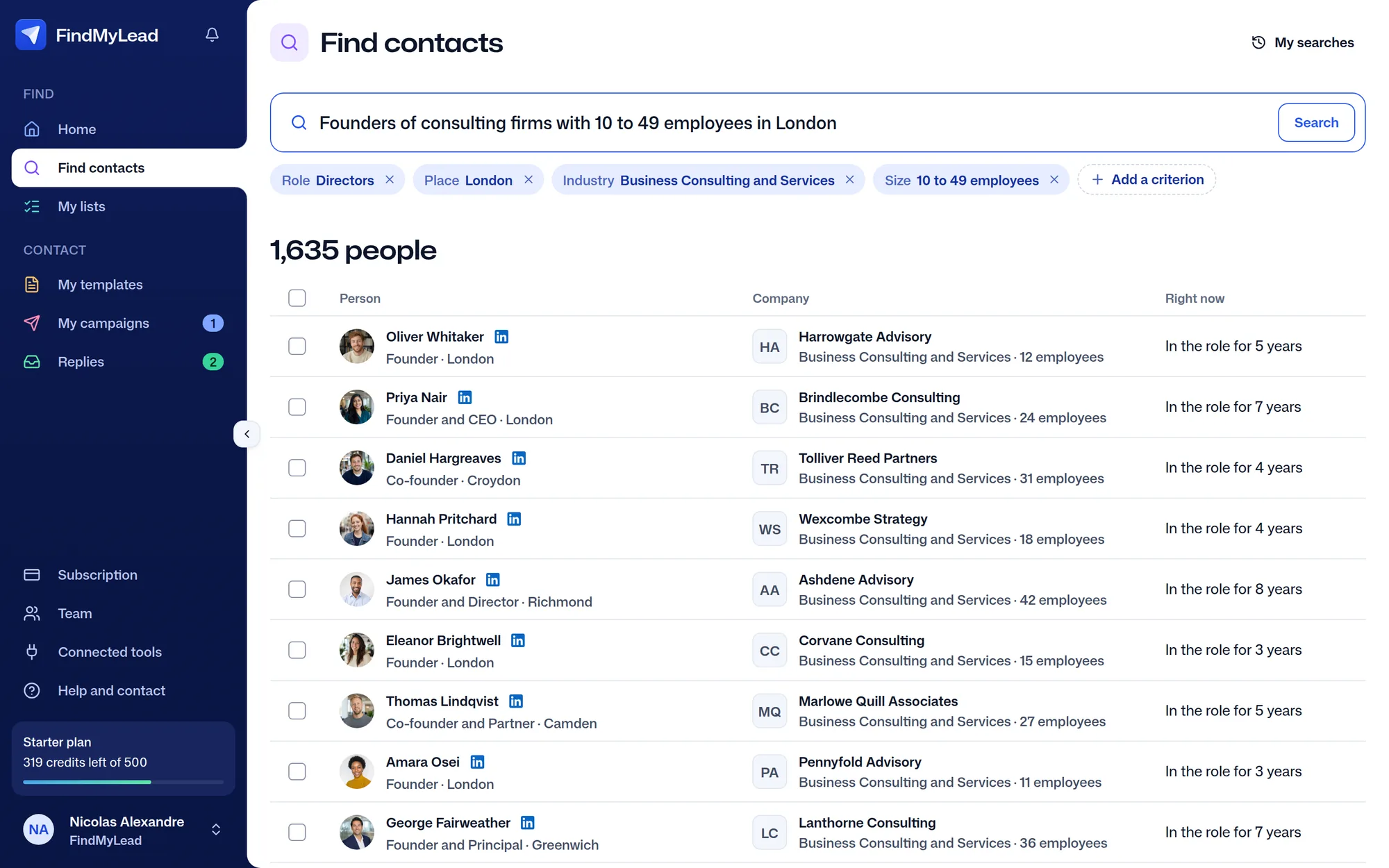
On FindMyLead, you write it in one sentence. The AI turns it into criteria shown on screen, which you can correct, and you see for free how many people match. Example: “Directors of consulting firms with 10 to 49 employees in Île-de-France”, 1,326 people in October 2026 (the founders’ use case). A credit pays for one contact and their LinkedIn profile; their work email is looked up at no extra credit, found or not. The AI then writes a LinkedIn message and an email for each person, which you review.
Who it suits: any director who knows which job they want to reach.
Their LinkedIn and their email, in one sentence.
Directors of small companies in Bordeaux, 10 to 49 employees
Free
2. Targeted cold email
Mass cold email damages your sending domain. A short cold email, sent to a small, well-chosen list, still gets replies.
A good email is under 100 words: one precise fact about the person, what they gain in one sentence, and a question they can answer in one line. Plan two or three follow-ups, each with a new angle (our 3-email follow-up sequence).
Send from dedicated, warmed-up addresses on a well-configured domain (our deliverability guide).
Who it suits: small companies with no marketing budget.
3. LinkedIn, one message at a time
For many directors who prospect, LinkedIn is the first channel. The profile shows the job, the company and the background; a short message, after an accepted invitation, gets read.
First comment on the person’s posts, with a real opinion. Then invite them, and write a message about their situation, not your offer.
Some tools automate invitations and messages from your account. LinkedIn can restrict an account that is too active: weigh that risk, covered in our article on Waalaxy alternatives.
Who it suits: directors who can spend a moment there every day.
4. Client referrals
A prospect referred by a client knows you before your first word. The sales cycle is shorter.
Do not count on it happening by itself. After a successful project, ask: “Do you know another company that would have the same need?” An email introduction, from your client to their contact, is worth more than a name.
Who it suits: any company with satisfied clients.
5. The phone, after a first message
A cold call works better when the person has already seen your name. Send an email or a LinkedIn message, wait two or three days, then call and refer to it.
Prepare a thirty-second opener. The goal is not to sell on the phone, but to get a meeting.
Who it suits: directors comfortable on the phone, for high-value offers.
6. Partnerships
Find companies that sell to the same target without competing with you. An accountant and an HR firm serve the same directors: each can recommend the other.
A partnership can be an informal referral, a joint webinar or a mention in each other’s newsletter.
Who it suits: firms whose offer complements another provider’s.
7. Content and SEO
Articles that answer your clients’ questions attract visitors for months. Aim at the questions they type before buying: “how to choose an IT provider”, “how much does an HR audit cost”.
It is slow: expect several months before the first requests.
Who it suits: companies that can write regularly, over time.
8. Webinars
A webinar on a topic your target cares about gathers people who gave you their email and showed interest.
Bring a real method, concrete cases, figures. The word about your offer comes at the end. Then write to the attendees, and to those who registered but did not attend.
Who it suits: companies with recognisable expertise and a defined target.
9. Niche communities
Some groups gather decision-makers around a topic: trade associations, local business clubs, LinkedIn groups for a trade, specialist forums.
Do not sell there. Answer questions, share what you know. Requests follow.
Who it suits: companies that know where their target gathers.
10. Ad retargeting
Retargeting shows an ad to people who already visited your website. A visitor to your pricing page then sees a client testimonial; a blog reader, a trial offer.
You need a minimum of traffic for the audience to be large enough.
Who it suits: companies whose website already gets regular visits.
How to combine these techniques
No technique is enough on its own. Start with one or two, measure the replies, then add the others.
For a services firm director, a simple combination: find people by job title (1), write to them on LinkedIn and by email (2 and 3), and ask every satisfied client for a referral (4).
On FindMyLead, the first three happen in one place: the search, the messages written by the AI, and the emails sent from addresses created in your company’s name, with automatic follow-ups. FindMyLead never acts on your LinkedIn account: you send the prepared message yourself. It costs €69 a month for 500 credits, for the whole team (our pricing).
To go further, read our complete guide to B2B prospecting.
Frequently asked questions
What is the most effective B2B prospecting technique?
The one that starts from the right person: a short message to the director or the relevant manager, on LinkedIn or by email.
How much time should I spend prospecting each week?
A fixed slot that you keep even in busy periods. A small amount every week beats a big campaign dropped after a month.
Should I automate LinkedIn?
It is a choice of risk. Automation tools act from your account, and LinkedIn can restrict an account that is too active. Sending prepared messages yourself avoids that risk.
Does cold calling still work?
Yes, especially after a first written message. The person knows your name, and the call is for getting a meeting, not for selling.