How a freelancer finds B2B clients without spending on ads
No ad budget, no endless network. Here is how a freelancer builds a steady flow of B2B clients with a free, direct method.
Finding clients on no budget, the freelancer's real challenge
When you go freelance, you often hear the same advice: "run ads, invest in Google Ads or LinkedIn Ads." The problem is that at the start, you have neither the budget nor the perspective to spend on advertising effectively. And even with a budget, ads often bring poorly qualified leads that waste your time.
The good news is that advertising is not necessary to find B2B clients. Freelancers who fill their calendar rarely do it through ads. They do it through a direct, free and targeted approach: going out to find the right companies yourself and reaching them intelligently.
Here is how to do it, step by step, without spending a euro on advertising.
Their LinkedIn and their email, in one sentence.
Directors of small companies in Bordeaux, 10 to 49 employees
Free
Define precisely the client you want
The most common mistake for a starting freelancer is wanting to work with everyone, out of fear of missing opportunities. "I do web development, writing, design, for all kinds of clients." The result: the message is vague and hooks no one.
The first task is to define your ideal client with precision. Not "companies", but for example "SaaS startups of 5 to 20 people that need technical content". The sharper the target, the more you can personalize your approach and stand out. A freelancer who is specialized and clear about their target converts far better than a generalist who talks to everyone.
To find this target, start from your strongest skills and the projects you enjoyed most. The intersection of the two draws the type of client to aim for.
Identify the right companies, for free
Once the target is defined, you need to find the companies that match it. This is where many freelancers exhaust themselves, digging through LinkedIn profile by profile for hours, with no method.
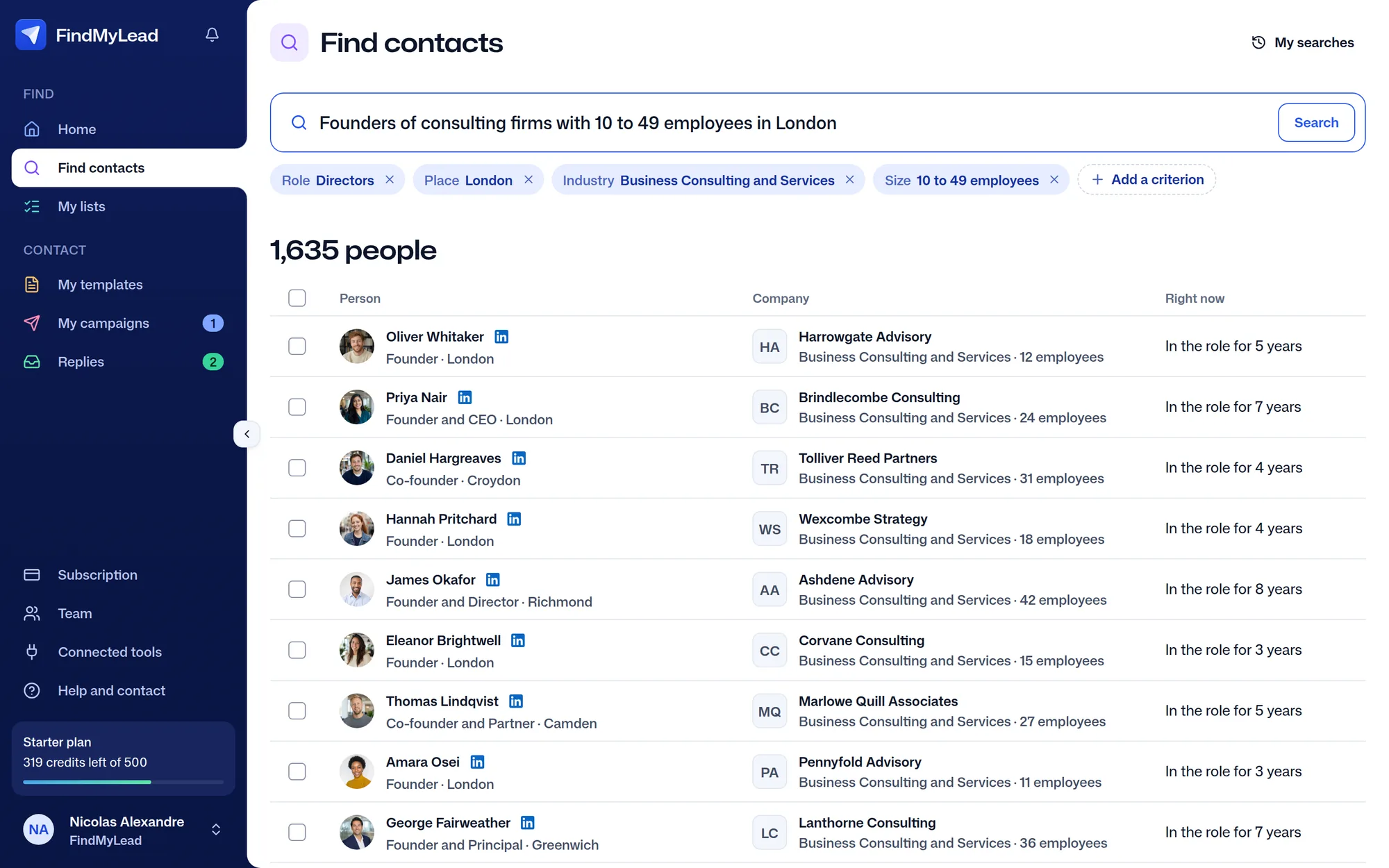
The effective approach starts from people, not from a list of companies. Describe who you want to reach: the role (most often the founder), the industry, the company size and the city. By combining these criteria, you get the names of the people who match your ideal client, without paying for ads to make them find you.
One valuable criterion for a freelancer: the company's age. Young, growing companies often need external skills and do not yet have dedicated providers. Their LinkedIn page shows the year they were founded: check it before you write.
Find the right contact
Contacting a company is useless if the message does not reach the right person. For a freelancer targeting small structures, it is almost always the founder who decides to call on an external provider.
The goal is to get their name and professional email, to write to them directly rather than going through a generic contact form. A personal message in the founder's inbox has infinitely more chance of succeeding than a spontaneous application buried in a shared address.
Send a short message that makes people want to reply
This is where everything is decided, and where most freelancers get it wrong. They send a message centered on themselves: "I'm a freelancer, here are my skills and my portfolio, do you need my services?"
That kind of message does not work. A good first message is about the prospect, not about you. It shows you looked at their company, asks a simple question, and suggests a light next step. The goal is not to land a project from the first email, it is to open a conversation.
A few principles that work:
Keep it short. A busy founder will not read a long message from a stranger. A few lines are enough.
Personalize for real. One sentence showing you know their business is worth a hundred times a copy-paste message. That is what sets you apart from the dozens of solicitations they receive.
Ask a question rather than selling. "How do you handle [your specialty] right now, in-house or with a provider?" invites a reply without committing to anything.
Follow up, because the reply rarely comes from the first message
Most replies do not come from the first email, but from follow-ups. A founder who did not answer is not necessarily uninterested, they simply forgot or postponed. A follow-up a few days later, bringing something new, often doubles the reply rate. Do not get discouraged by the silence of the first send.
Make it a regular habit
The real secret of a freelancer who never runs out of clients is not luck or a big ad budget. It is regularity. Setting aside a fixed time each week to identify new targets, reach out, and follow up. That consistency is what turns prospecting into a predictable flow of clients, instead of suffering the swing between overloaded and empty periods.
This regularity matters all the more for a freelancer because prospecting must continue even while on an assignment. Otherwise, once the assignment ends, you find yourself with nothing in the pipe and start again from scratch.
In summary
Finding B2B clients without spending on ads, as a freelancer, rests on a simple and free method: define your target precisely, identify the right companies through official data, find the right contact, send a short and personalized message centered on the prospect, and follow up consistently.
It is not a matter of budget, it is a matter of method and consistency. And once the process is in place, it runs without costing a cent in advertising.
That is exactly what FindMyLead offers freelancers: describe your ideal client in one sentence, see the matching directors with their LinkedIn, and launch a campaign where the AI writes the LinkedIn invitation and the email for each of them. Enough to fill your calendar with no ad budget. Step by step: finding your first B2B clients without a sales team.